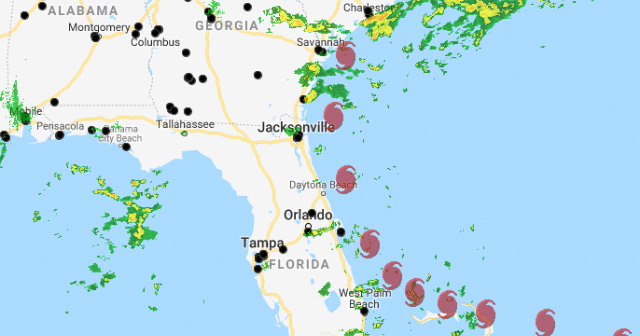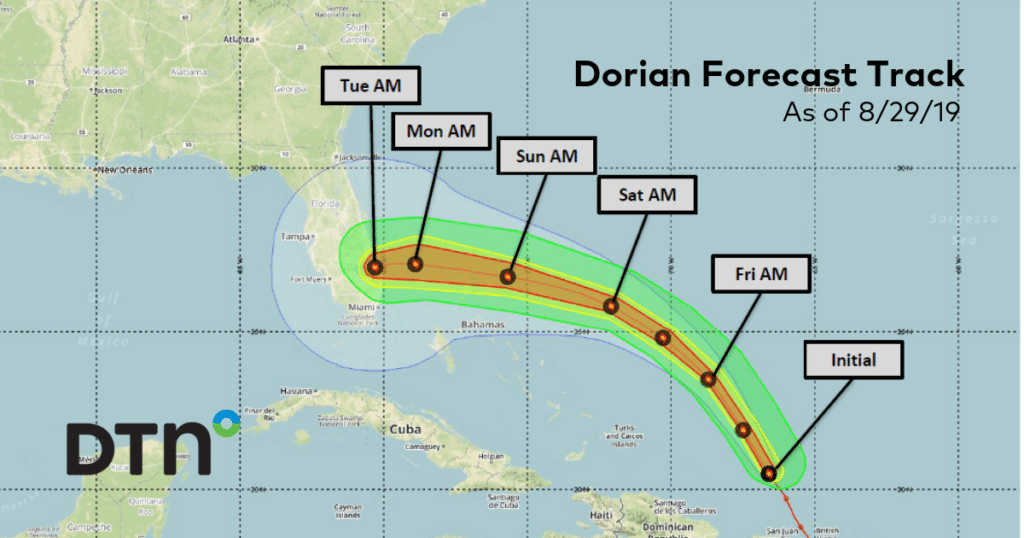









Hurricane Dorian continues to track off the coast of the U.S. Gasoline and diesel liftings at the terminals DTN is monitoring have started to decline (except for Savannah).
Gasoline liftings starting to decline ahead of Hurricane Dorian
Hurricane Dorian continues to track off the coast of the U.S. Gasoline and diesel liftings at the terminals DTN is monitoring have started to decline (except for Savannah).
Liftings remain above normal in both Florida terminals. Prices are stabilized and only slightly higher. Wholesale prices seem to have flattened out and are now only slightly higher than where they were before the atypical lifting began.
Opportunistic gasoline prices spiked Friday in advance of Hurricane Dorian reaching landfall as Florida residents filled their tanks and possibly headed inland. The Orlando and Jacksonville charts, produced by DTN, reflect regular gasoline daily terminal liftings along with the wt. average rack price (solid blue line). The dotted line is a linear regression trend line.
Gasoline and diesel markets appear to be in good shape in advance of Hurricane Dorian reaching Florida shores. DTN is monitoring daily terminal volumes and prices once Dorian arrives and moves out.
Heading into the heart of the tropical storm season, we’re seeing that our gasoline supply and demand balances are very comfortable in the United States. That said, an active weather season could have significant impacts as storms develop in key geographic areas.
Even at current oil supply levels, current geopolitical issues will likely continue to cause tension in the market.
A key metric we are watching is the slowing of U.S. crude oil production growth in the face of negativity about global recession and the potential slowing of global oil demand growth.
Partnership With DTN Helps Stage 5 Trading Deliver a Personal Touch – Discover why Stage 5 Trading relies on DTN to offer a more reliable data feed to their customers.
August 1
Learn how simple technical tools can clue us into the next big trend in oil. We’ll examine horizontal support and resistance levels, combine multiple trading time frames, and consider highly-correlated assets.
Trading on anything but real-time data can be costly if you’re too late to detect a bullish trend or a bearish fall within a stock. There are options to obtain real-time data, regardless if you are part of a large corporation or an independent active trader.